The Integrate martial arts " SHINRYU 神流 - 武芸 BUGEI " is composed of SAMURAI & NINJA BUGEI and XINYI GONGFU, namely MCMA《 Mixed Classical Martial Arts 》
* 武 ' BU ' is martial, 芸 ' GEI ' is the meaning of arts by Japanese. BUGEI, BUJUTSU, BUDO ... These meanings are nearly the same
神流武芸 SHINRYU-BUGEI is the essence of Shinto Youshin-ryu and Kukishin-ryu Bujutsu , also contain Xinyi Gong-Fu
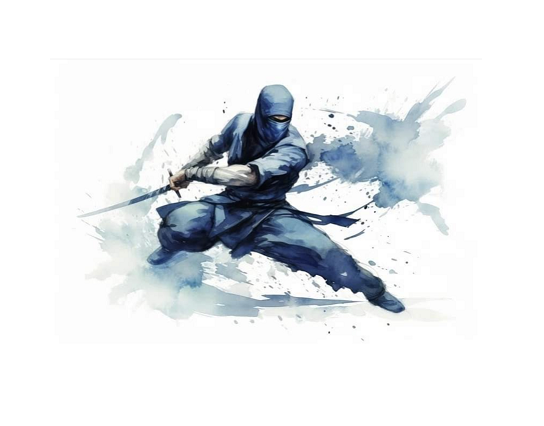
SAMURAI & NINJA BUGEI
◎ NINJA ARTS 九鬼神流 Kukamishin-Ryu (or Kukishin)
Ninja 忍者 were a type of warrior who specialized in unconventional warfare such as infiltration, sabotage and assassination during the age of the samurai. Another way of calling them is "shinobi 忍", meaning "those who act in stealth". Ninja employed deception and forgery tactics to take opponents out by surprise. Due to their unorthodox methods which contradicted the way of the warrior (bushido 武士道), the ninja were not credited with the same honor as the samurai.
The diverse range of skills practiced by the ninja is called Ninjutsu - the art of stealth - and includes training in armed combat, weapon techniques, military strategy, meteorology, geometry and breathing synthesis.
Ninjutsu was passed down through generations within families or directly from teacher to a selected one or few disciples. This secrecy in part explains why little factual information exists about the ninja, giving rise to lots of stereotyping of them both within Japan and in the West.
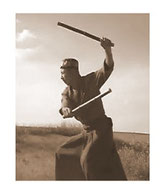
Ancient Ninja was an secret agent, they could not have a prominent weapon like samurai. The weapon of Ninja was an inconspicuous one that is easy to hide, such as a short sword or a stick etc...
The Kukishin-ryu inherits genealogy of Kumano Ninja, it was also closely related to the Kumano Shugendo, since ancient times it was trained in the deep forests and mountains of Kumano
Kumano is the spiritual heartland of Japan, where nature and spiritual enlightenment interplay. Down the centuries, its picturesque rivers, soothing thermal hot springs, waterfall-laced mountains and verdant eerie forests have appealed to both the body and the soul.
It is a region situated on the southern part of the Kii Peninsula in Japan, it includes parts of Mie ,Wakayama ,Nara Prefecture.
Shugendo 修験道 or Yamabushi 山伏 is Mountain asceticism, involved worshipping mountains as gods in the belief that people's daily lives, the gods, and Buddha...
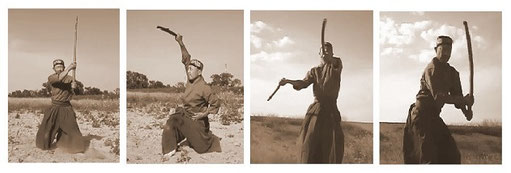
◎ SAMURAI ARTS 神道楊心流 Shinto Youshin-Ryu
The samurai were the warriors of pre-modern Japan. They later made up the ruling military class that eventually became the highest ranking social caste of the Edo Period (1603-1867). Samurai employed a range of weapons such as bows and arrows, spears and guns, but their main weapon and symbol was the sword.
The battle technique of Samurai was passed down to ancient martial arts, from which modern Judo Kendo Aikido and so on were derived.
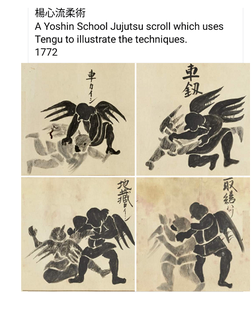
The Shinto Yoshin-ryu is an old martial art originating in the Edo period, and skills such as jiu-jitsu and swordsmans are passed down
It was founded late in the Edo period by a Kuroda clan retainer named Katsunosuke Matsuoka (1836–1898) Katsunosuke was born in Edo-Hantei, the Edo headquarters of the Kuroda clan in 1836. Katsunosuke opened his first dōjō in 1858 in the Asakusa district of Edo where he taught Tenjin Shinyō-ryū jūjutsu.
He also stood in for his teacher Sakakibara Kenkichi, fourteenth headmaster of the Kashima Shinden Jikishinkage-ryū school of kenjutsu, during Sakakibara's service to the shogun Tokugawa Iemochi.
Over the years Katsunosuke became convinced that the contemporary jūjutsu systems of the late Edo period had lost much of their military usefulness, evolving into systems driven more by individual challenge matches than effective military engagement.
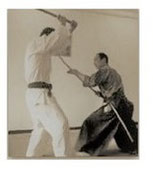
☆ Use of internal strength - KI 氣 energy
Kiai 気合 and Aiki 合気 use the same kanji (transposed) and can be thought of as the inner and the outer aspect of the same principle.
Kiai relates to the manifestation, emission or projection of ones own energy (internal strength), while Aiki relates to the merging of one's energy with the energy emitted from an external source (blending).
Thus kiai is harmony with our own, internal energy while aiki is harmony with an attacker's energy.
Kiai consists of all parts of the body being unified and directed to one intent. Aiki, ultimately has to do with a very good ability to manipulate kiai upon contact so that the player blends his ki with the attacker ki instantaneously. This use of ki will involve the use of kokyu power, breathing is coordinated with movement.
Kokyu Ryoku 呼吸力 is the natural power that can be produced when body and consciousness (mind) are unified. The term "kokyu" is can also be used to describe a situation in which two opponent's are moving with appropriate timing.
Bukijutsu - weapons arts
Kenjutsu Kodachi
Bojutsu Jitte Soujutsu
刀剣 槍鉾 棒杖 小太刀
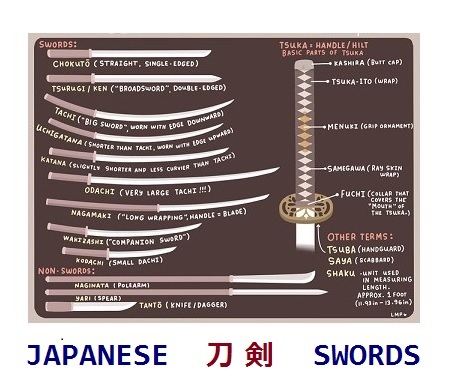
Kenjutsu is the samurai's long sword art, Ninja Kodchi is a short sword. It requires the use of blades (especially Japanese blades such as the katana, wakizashi 脇差). Kenjutsu involves powerful, high commitment strikes to selected targets in order to kill the opponent.
This art was studied and practiced by the samurai since the 11th century. In the 16th century, there was an explosion of styles, with many being formed between then and the present.
Our Kenjutsu & Kodachi arts is composed of the techniques of Youshin-ryu & Kukishin-ryu .
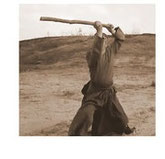
The Soujutsu 槍術 is spear techniques, the central core of techniques make micro explosion with spiral power, it is elaborated concretely by Kuden(diction) according to classic custom.
This with the practice freely struck mutually besides practice of Kata(form) is performed without a protector by the wooden sword or stick called "Gekiken 撃剣 or 差し合い Sashiai ". The test match of Gekiken is open and anyone can participate freely.
XINYI GONG-FU
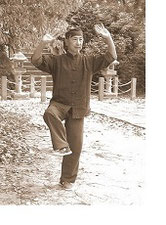
心 意 功 夫
The system of XINYI is classified Three stages, evolved First : Xinyiquan (Henan style) 河南心意拳 ➡ Second : Xingyiquan(Hebei style) 河北形意拳 ➡ Third : Yiquan (Dachanquan) 意拳 / 大成拳
Xinyiquan is a very old Chinese martial art that most believe originated in the early 1600s. It is a very powerful art which is classified as an internal system like it's sister arts Taijiquan and Baguaquan. However, Xingyi's mindset is that of an aggressive nature, Xingyi smashes right through the opponent in a linear fashion with an unrelenting attack.
Legend says that the origin of xingyiquan was a secret kung-fu "Xinyi-ba" in Sholin Temple, that was improved to Xinyiliuheqian(henan style), more evolved to Xingyiquan(hebei style), still more to Yiquan, so Xinyiquan is classified 3 types.

The First Stage XINGYILIUHEQUAN
Intention & Mind Fist
Henan Xinyiquan has also been known as six harmony's boxing ( Liu He Quan ), the style that we recognise today has a history of over three hundred years.The basis of Xinyiquan is the Tenth Animals system, which can be translated as Drgon Form, Tiger Form, Cookerel Form, Horse Form, Monkey Form, Snake Form, Swallow Form, Sparrow Hawk Form, Eagle Form, Bear Form.

The Second Stage XINGYIQUAN
Form & Intention Fist
The heart of Hebei Xingyi are five fist forms ( "wu xing" ) . These are short repetitive forms each depicted by the Chinese five elements of metal, wood, water, fire and earth. Each one generates a different kind of energy or fighting power and each one corresponds to an internal organ of the body. Advanced training introduces twelve animal forms based on the five fists.

The Third Stage YIQUAN
Mind Boxing other named Dachengquan - Grand Achievement Fist
THE HISTORY Yiquan has its roots in Xingyiquan and was developed by Master Wan xiangzhai (1886-1963) in the middle of the 1920s. Wang was the last master disciple of the most famous Xingyiquan Master of that time, Master Guo Yunshen, who came from the province Hebei. As a result of the great commitment, talent, and character of Wang Xiangzhai Guo Yunshen taught his last master disciple the secrets of the Zhangzhuang exercises.
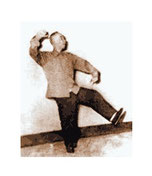
After his master death Wang went off on travels across China for many years to prove the quality of his martial art. In this time he exchanged experiences with many famous masters from different martial arts ( Shaolin-Xinyiba Style, Crane Boxing, different Xinyiquan Styles, Baguazhang, Taijiquan ) and thus completed his own martial art in theory and practical experience.
Wang Xiangzhai dedicated his whole life to the search for the essence of the inner martial arts (Neijiaquan) and the systematization of their principles. Wang Xiangzhai put the Zhanzhuang (Pole Standing exercises) and Shili (exercises to feel Inner Strength) in the center of his training with the aim to return to the quintessence of the inner martial arts.
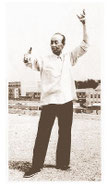
Later in his life he spent his time with maintaining health and preventing sicknesses as well as with healing illnesses with the help of Yiquan. Many patients who did not improve under common therapy were cured with the aid of Yiquan.
The therapeutic benefit of Yiquan was academically proven by Dr Yu Younian, a late disciple of Wang Xiangzhai. Yao Zonqxun, one of his most noticeable disciples, as his successor. The latter passed on his knowledge to both of his sons, Yao Chengguang and Yao Chengrong.
" Form becomes formless, it returns to simplicity, The Principle is the way . "
" Posture follows movement like a shadow ; every movement begins in posture and ends in posture "
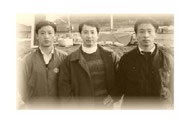
As Japanese martial arts was mainly based on weapon skills and throwing techniques, Hiro K went to China to compensate for striking techniques. He was accepted as the disciple of Yao brothers in Beijing China in 1991, and besides learned Yiquan methods from Dr Yu Younian and other Wan Xiangzhai direct teachers.
He traveled across China and to prove the quality of his arts, on this time learned Hebei & Henan Xingyiquan, he obtained good results for integrate research of Yiquan. Later he developed ' SHINRYU 神流-武芸 BUGEI ' ( mixed yiquan martial arts and Japanese Bujutsu) .
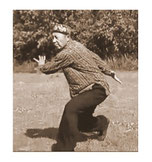
SHINRYU-BUGEI is the essence and core of Chinese and Japanese martial arts, it is also simple to learn and easy to apply in real defense situations, or studying for physical fitness, and especially, you can utilize to develop any dances or physical works.
It is a classical martial art that inherits the tradition, but the practice system is rationally modernized
Excellent techniques of synthetic martial arts are classified into three parts.
In the case of SHINRYU -BUGEI ...
1 The Weapons Arts - Ninja & Samurai Arms ( sword spear stick cudgel... ) Arts
2 The Grappling and Throwing Arts - Samurai Jujutsu , Ninja Taijutsu
3 The Striking Arts - Yiquan ( include Xinyiquan ), Ninja Atemi ( hitting vital point )
We can give lesson at your home or accommodation at any time . Come and learn in a comfortable atmosphere.
Private Lesson Fee 90 min ¥6000 JPY 120 min ¥7000 2-3 persons each ¥5000 over 4 persons each ¥3000
Trial Lesson 80 min 20USD~
Let's give it a try !